Triangulation-Based Candidate Generation

Generating candidate points via Delaunay triangulation for acquisition optimization.

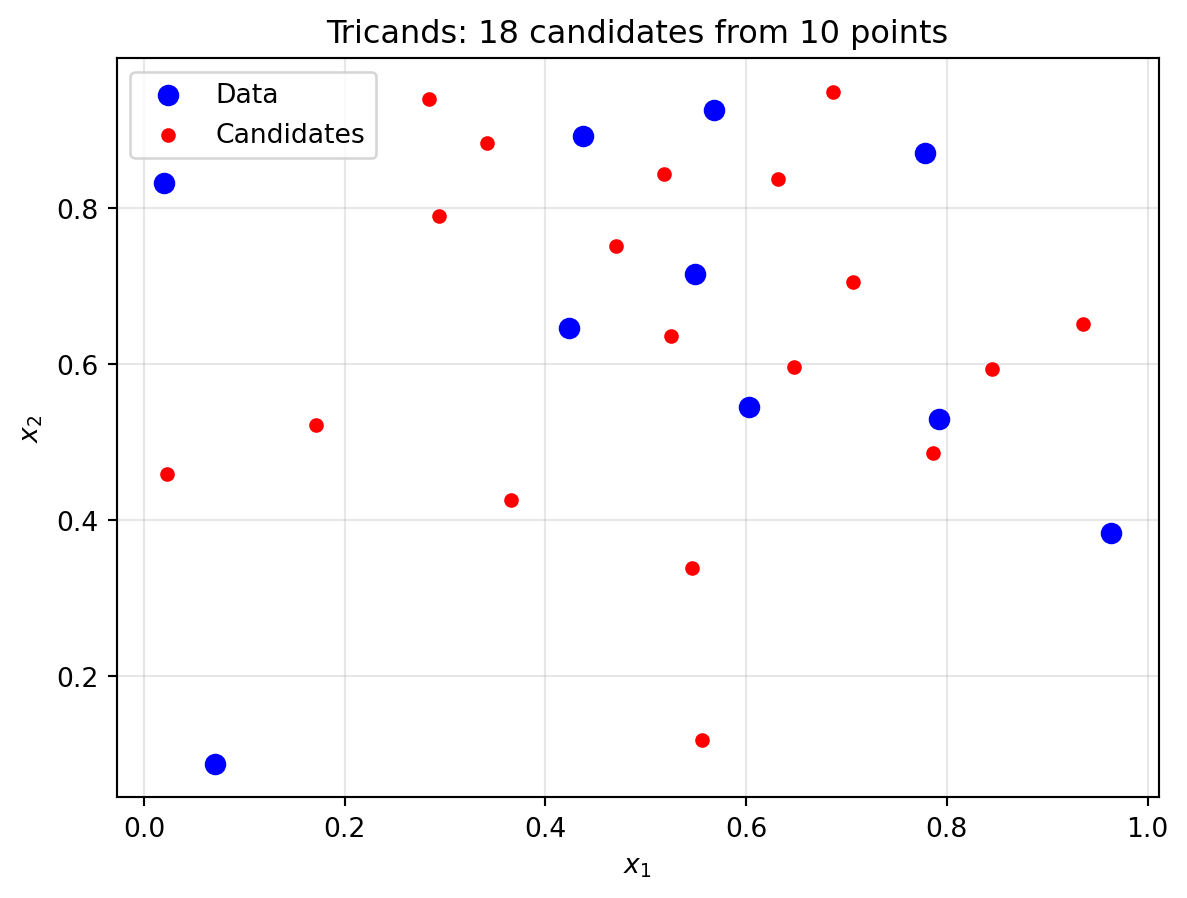
The tricands module generates candidate points for infill by computing the Delaunay triangulation of the existing evaluated points. This provides a geometry-aware alternative to global optimizers like differential evolution for maximizing the acquisition function.


How It Works

Given a set of evaluated points, tricands():

  1. Computes the Delaunay triangulation of those points.
  2. Generates interior candidates at the midpoints (centroids) of each simplex.
  3. Optionally generates fringe candidates that extend beyond the convex hull toward the search space boundary.
  4. Returns a combined set of candidate points.

The interior candidates explore gaps between existing points. The fringe candidates push the search toward unexplored boundary regions.


Basic Usage

import numpy as np
import matplotlib.pyplot as plt
from spotoptim.tricands import tricands

np.random.seed(0)
X = np.random.uniform(0, 1, size=(10, 2))

candidates = tricands(X, p=0.5, fringe=True)

plt.scatter(X[:, 0], X[:, 1], c="blue", s=50, label="Data", zorder=5)
plt.scatter(candidates[:, 0], candidates[:, 1], c="red", s=20, label="Candidates", zorder=4)
plt.xlabel("$x_1$")
plt.ylabel("$x_2$")
plt.title(f"Tricands: {candidates.shape[0]} candidates from {X.shape[0]} points")
plt.legend()
plt.grid(True, alpha=0.3)
plt.show()

print(f"Data points: {X.shape[0]}")
print(f"Candidates : {candidates.shape[0]}")

Data points: 10
Candidates : 18

Parameters

Parameter Default Description
X (required) Existing data points, shape (n, d)
p 0.5 Fraction for fringe extension beyond convex hull
fringe True Whether to include fringe candidates
nmax None Maximum number of candidates to return
lower 0 Lower bound of the search space
upper 1 Upper bound of the search space

Integration with SpotOptim

Use tricands as the acquisition optimizer by setting acquisition_optimizer="tricands":

from spotoptim import SpotOptim
from spotoptim.function import sphere

opt = SpotOptim(
    fun=sphere,
    bounds=[(-5, 5), (-5, 5)],
    acquisition_optimizer="tricands",
    tricands_fringe=True,
    max_iter=20,
    n_initial=10,
    seed=0,
)
result = opt.optimize()

print(f"Best f(x) : {result.fun:.6f}")
Best f(x) : 0.210910

The hybrid "de_tricands" mode randomly alternates between differential evolution and tricands, controlled by prob_de_tricands. See Acquisition and Infill for details.

See Also