plot.visualization.plot_design_points

plot.visualization.plot_design_points(
    X,
    i=0,
    j=1,
    agg='mean',
    show=True,
    **kwargs,
)

Plot design points projected onto two selected dimensions.

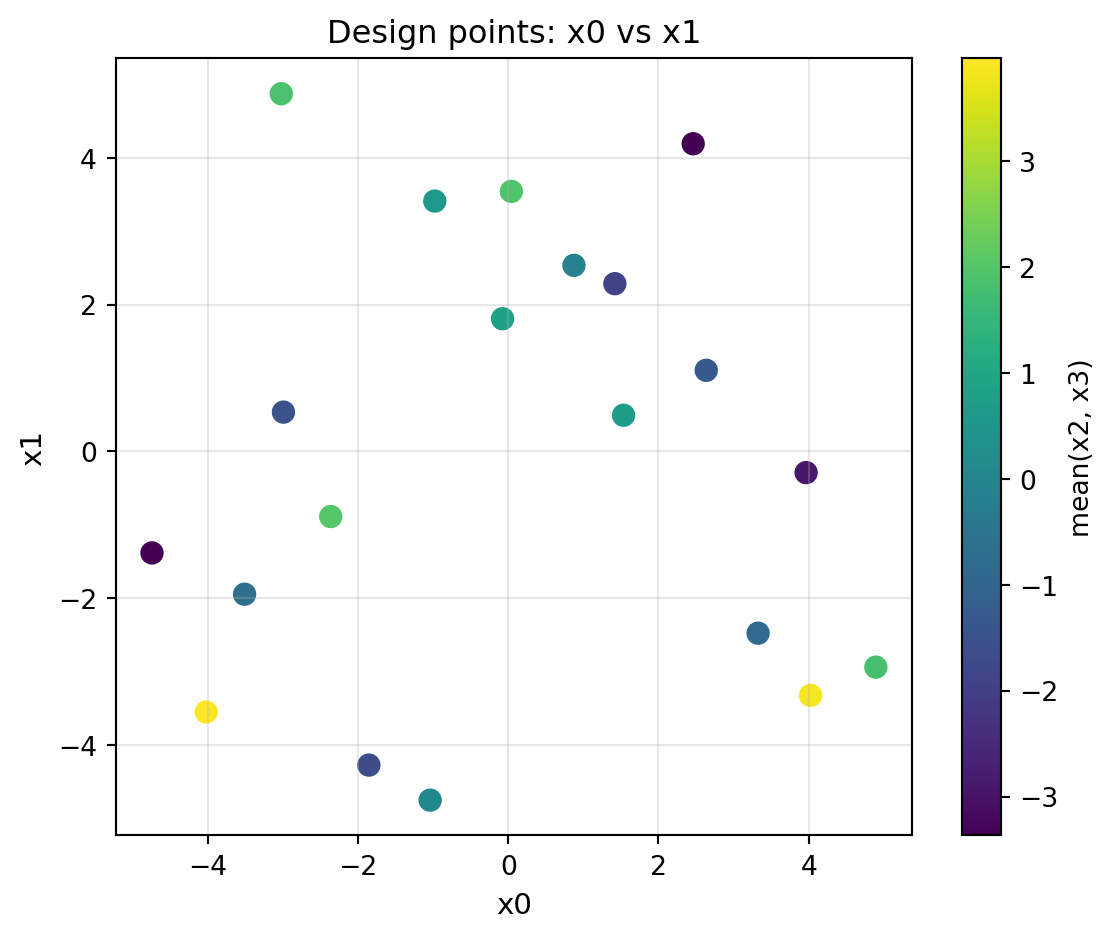
Displays a scatter plot of design points using dimensions i and j as the axes. When X has more than two dimensions, all remaining dimensions (≠ i and ≠ j) are aggregated per point using the agg function, and the result is used to colour the markers.

Parameters

Name Type Description Default
X np.ndarray Design matrix of shape (n_samples, n_dim). Each row is one design point. required
i int Index of the dimension to plot on the x-axis. Defaults to 0. 0
j int Index of the dimension to plot on the y-axis. Defaults to 1. Must differ from i when n_dim > 1. 1
agg str or callable Aggregation applied to the dimensions that are not plotted (i.e. every column except i and j). Supported strings: "mean", "median", "min", "max". A callable f(arr, axis) is also accepted (e.g. np.std). The aggregated value is used as the colour of each marker so that spread across the hidden dimensions is visible at a glance. When n_dim == 2 this parameter is ignored (no hidden dims). Defaults to "mean". 'mean'
show bool If True, call :func:matplotlib.pyplot.show before returning. Set to False when running inside tests or scripts that manage display manually. Defaults to True. True
**kwargs object Additional keyword arguments forwarded to :func:matplotlib.pyplot.subplots (e.g. figsize) and to :func:matplotlib.axes.Axes.scatter (e.g. s, cmap, alpha). figsize is intercepted and passed to subplots; all other keys go to scatter. {}
Returns

Name Type Description
object matplotlib.figure.Figure: The created figure object. Call
object plt.show() or fig.savefig(...) on the returned object as
object needed.

Raises

Name Type Description
ImportError If matplotlib is not installed.
ValueError If X is not a 2-D array, has fewer than two columns, or if i / j are out of range or equal.

Examples

import numpy as np
from spotoptim import SpotOptim
from spotoptim.function import sphere
from spotoptim.plot.visualization import plot_design_points

opt = SpotOptim(
    fun=sphere,
    bounds=[(-5, 5), (-5, 5)],
    n_initial=10,
    seed=42,
)
# Generate a Latin-hypercube initial design (in original scale)
X0 = opt.get_initial_design()

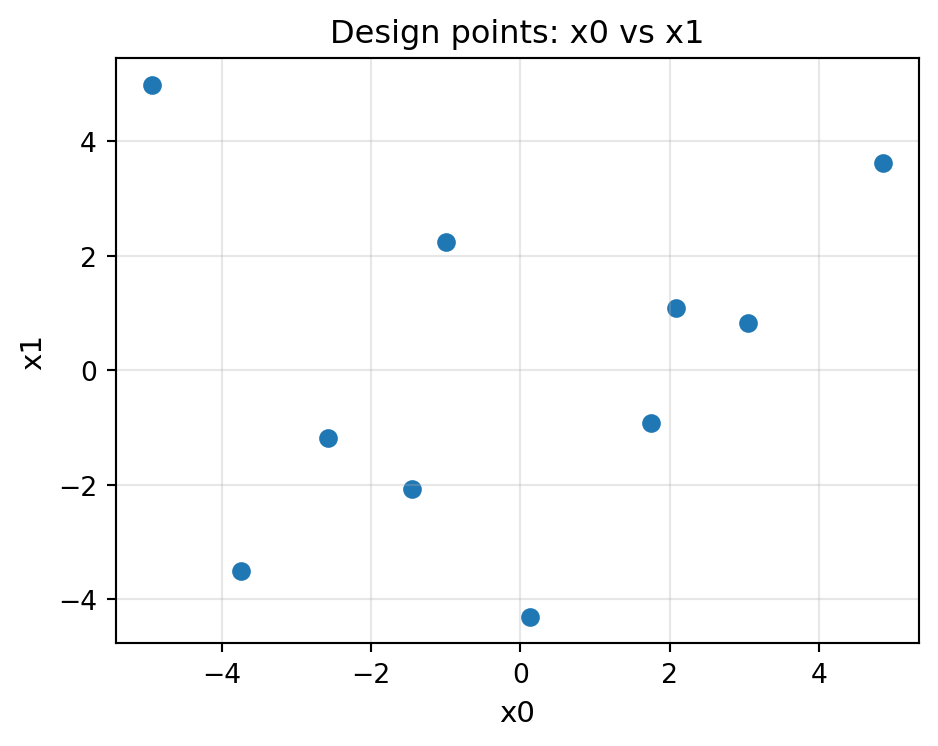
# 2-D design – simple scatter on both dimensions
fig = plot_design_points(X0, i=0, j=1, figsize=(5, 4))

import numpy as np
from spotoptim import SpotOptim
from spotoptim.function import sphere
from spotoptim.plot.visualization import plot_design_points

opt = SpotOptim(
    fun=sphere,
    bounds=[(-5, 5)] * 4,
    n_initial=20,
    seed=42,
)
X0 = opt.get_initial_design()

# 4-D design – colour encodes the mean of the two hidden dimensions
fig = plot_design_points(X0, i=0, j=1, agg="mean", figsize=(6, 5), s=60)